Cashew Grades Explained: What W180, W240 and W320 Actually Mean
Almost every cashew pack sold in India carries a code like W180, W240 or W320 — and most shoppers have no idea what it means beyond "bigger number, cheaper cashews." That instinct is directionally right, but the actual system is simpler, and more useful, than it looks once you know what it's really measuring.
What the W-number actually means
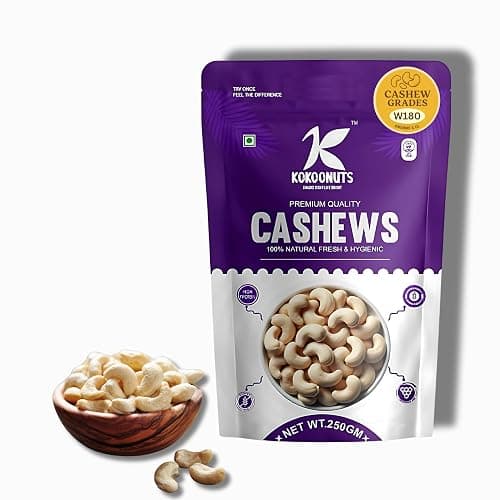
The "W" stands for whole (as opposed to broken or split pieces), and the number is the approximate count of whole kernels in one pound (454g) of cashews. So W180 means roughly 180 kernels per pound — large kernels, since it takes fewer of them to make up a pound. W450 means roughly 450 kernels per pound — much smaller kernels, since it takes more of them.
That's the entire system: a lower number means bigger individual nuts, and a higher number means smaller ones. It's a size classification, standardized enough that W180 from one brand and W180 from another should be roughly comparable in kernel size — though brands vary in how strictly they grade.
Size ≠ quality — the myth worth busting
The W-grade says nothing about freshness, roast quality or flavor — only kernel size. A fresh, well-stored W320 will taste better than a stale W180 every time. Paying a premium for W180 buys you visually larger, more presentation-friendly kernels, not a guarantee of better cashews.
This matters because grade is often marketed as though it were a quality tier, when it's really closer to a size spec — similar to how a jumbo egg isn't a "better" egg than a large one, just a bigger one.
Which grade to buy for what
W180 suits gifting and festive presentation, where the visual size of whole kernels is genuinely part of what you're paying for.
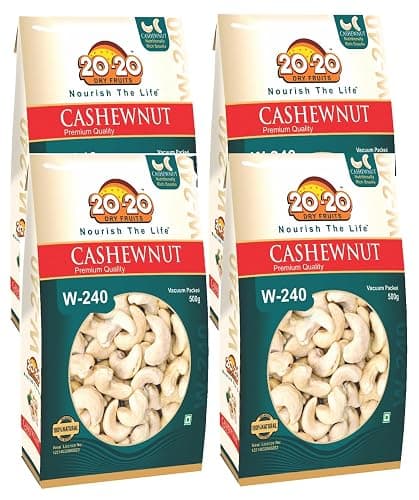
W240 is the common everyday size most Indian households actually snack on — a solid middle ground between kernel size and price-per-kg.
W320 (and smaller grades) are the practical choice for cooking, baking or high-volume snacking, where kernel size barely matters but price-per-kg does.
Price-per-kg is still the real comparison
Because grading isn't perfectly enforced across every seller, the most reliable comparison is still price-per-kg within the grade you want — a W240 that's 20% cheaper than another brand's W240 is a genuinely better deal, not just a smaller pack. That's the number every listing on this site is normalized to.